





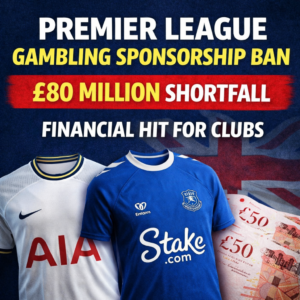
The financial impact of the Premier League gambling sponsorship ban is becoming increasingly clear, with clubs bracing for a collective shortfall of up to £80 million ahead of the 2026–27 season.
As front-of-shirt betting sponsors begin to disappear, new figures and industry insight reveal a growing divide within the league, one that disproportionately affects clubs outside the traditional elite.
A Voluntary Ban with Major Financial Consequences
The Premier League agreed to phase out front-of-shirt sponsors in 2023 following government pressure and wider regulatory scrutiny.
While the move was positioned as a proactive step to reduce gambling exposure in football, the financial consequences are now surfacing.
According to reporting highlighted by The Guardian, clubs are facing a combined loss of an estimated £80 million in shirt sponsorship revenue, with several still without replacement deals. The transition period allowed time to find new partners, but the market response has fallen short of expectations.
Clubs Struggle to Replace Lost Gambling Revenue
The scale of the issue is reflected in the number of clubs still searching for sponsors.
Nine Premier League teams are currently without confirmed front-of-shirt deals, while a wider group has yet to finalise contracts for the upcoming season.
Even where agreements have been reached, the value of those deals has dropped significantly. Industry estimates suggest that sponsorship deals for mid-tier clubs have fallen by as much as 50% compared to previous gambling-backed deals worth between £8 million and £12 million per year.
In several cases, clubs have turned to existing commercial partners, such as training kit or stadium sponsors, to fill the void, often at reduced rates.
Why Gambling Sponsors Paid Well
The financial gap left behind is not accidental. Gambling companies have historically paid a premium for shirt sponsorships due to the Premier League’s global visibility. Football partnerships allowed betting brands to capitalise on overseas markets and capture millions of viewers every week.
With those companies now removed from the most visible advertising space in football, clubs are competing for a smaller pool of sponsorship that is unwilling to match previous valuations.
Big Six Protected, Rest of League Exposed
Top-tier clubs, including Manchester United, Liverpool, Arsenal, and Manchester City, continue to command long-term sponsorship deals worth £40 million to £60 million per year from global brands.
In contrast, clubs outside of this group face a much more difficult commercial environment.
As noted in the Guardian report, the removal of gambling sponsorship has widened the gap between the league’s wealthiest clubs, with smaller clubs struggling to attract equivalent partnerships.
One senior executive described the current market as “very difficult,” with most clubs accepting lower-value deals simply to secure a sponsor.
A Market Reset Ahead of the 2026–27 Season
As the 2026–27 season approaches, clubs are entering a compressed negotiation window while adapting to a fundamentally altered sponsorship landscape.
Many could begin the season without a front-of-shirt sponsor, a scenario that would have been almost unthinkable in previous years.
Others are restructuring deals, shifting gambling brands to sleeve sponsorships, which is permitted under current rules.
Wider Impact on Football Finance
Beyond individual clubs, the Premier League gambling sponsorship ban raises questions about football finance.
‼️ Reduced commercial income could:
❌ Limit transfer spending and squad investment
‼️ Increase financial pressure on mid- and lower-table clubs
Further entrench the financial dominance of the top six
There are also concerns about the knock-on effect across the wider football pyramid, particularly as discussions continue on revenue redistribution and the introduction of an independent football regulator.
Part of a Larger Regulatory Shift
The sponsorship ban does not exist in isolation. It forms part of a broader tightening of gambling regulation in the UK, including:
⭐ Affordability checks for bettors
⚡ Increased scrutiny of advertising
⭐ Restrictions on partnerships with unlicensed operators
Together, these measures reflect a significant effort to reduce the visibility of gambling and strengthen consumer protections. However, they also highlight the financial interdependence of sports and betting.
Uncertain Future for Sponsorship Deals
The long-term outcome of the ban remains unclear. While clubs are expected to adapt, the immediate impact suggests a more competitive and less lucrative sponsorship market.
There is also the possibility that gambling companies will redirect their marketing budgets. Digital platforms and markets outside the UK are an option as restrictions are less stringent.
For now, the Premier League faces a transitional period and one that could reshape how clubs generate commercial revenue in the years ahead.